Research area

Underwater Networks

Connecting distributed underwater systems

Research Overview

Exploring New Frontiers in Underwater Networks

Underwater networks enable multiple sensors, acoustic modems, autonomous vehicles, and surface gateways to cooperate over large marine areas. Unlike a single acoustic link, an underwater network must coordinate many devices while dealing with long propagation delays, limited bandwidth, intermittent connectivity, changing channel conditions, and strict energy constraints.

Our research develops communication protocols, distributed algorithms, and integrated network architectures for reliable, energy-efficient, and scalable underwater systems.

Research Programme

Research workstreams

Distinct lines of enquiry, connected by one shared validation pathway.

Medium access and channel coordination

When several underwater devices share the same acoustic channel, simultaneous transmissions can cause packet collisions and long communication delays. Conventional terrestrial networking protocols are often unsuitable because underwater propagation is slow and channel conditions vary significantly.

We design medium access control protocols that coordinate transmissions while accounting for:

  • Long and variable propagation delays
  • Hidden-terminal and exposed-terminal effects
  • Limited acoustic bandwidth
  • Packet collisions and retransmissions
  • Asynchronous device operation
  • Mobility and changing network topology

Our objective is to increase channel utilization and packet delivery reliability while reducing energy consumption and communication latency.
Energy-efficient networking

Underwater sensor nodes are often expected to operate for months or years without battery replacement. Network protocols must therefore minimize communication activity while ensuring that important data reaches the destination.

Our research includes:

  • Adaptive duty cycling and sleep scheduling
  • Energy-aware medium access control
  • Selective activation of communication interfaces
  • Event-triggered data transmission
  • Traffic-aware communication scheduling
  • Reduction of unnecessary retransmissions
  • Balancing energy consumption across network nodes

These approaches extend network lifetime and reduce the risk that individual nodes become unavailable because of excessive communication load.

Routing and multi-hop communication

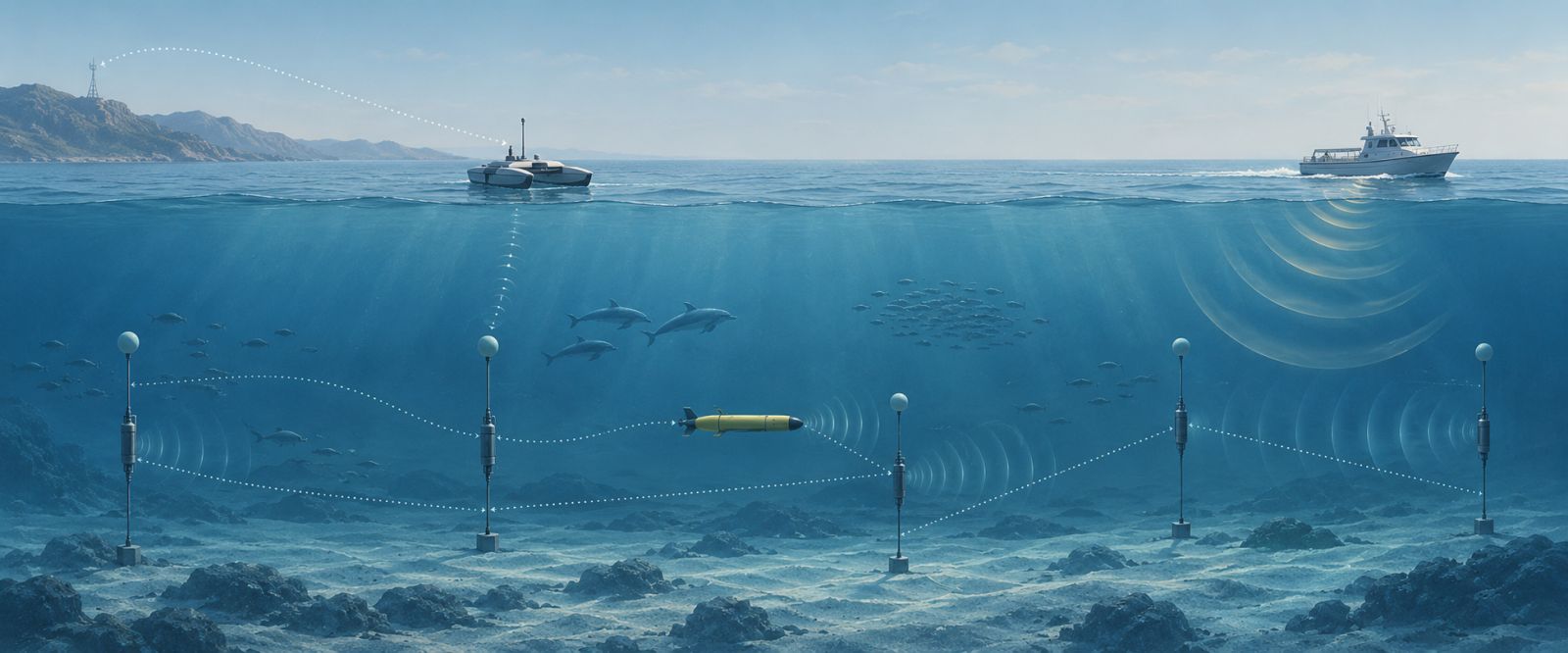
Direct communication with a surface gateway may not be possible for distant, deeply deployed, or obstructed underwater devices. Multi-hop networking allows data to be forwarded through intermediate nodes.

We develop routing methods that select communication paths according to link reliability, distance, delay, energy availability, and network conditions.

Our routing research targets:

  • Reliable long-range operation
  • Adaptive path selection
  • Recovery from node or link failures
  • Reduced end-to-end delay
  • Balanced energy consumption
  • Support for changing and partially connected topologies

Multi-hop communication can extend coverage beyond the range of an individual acoustic modem and improve network resilience.

Distributed underwater sensing

Underwater networks allow observations from multiple locations to be combined into a coordinated view of the marine environment.

We investigate distributed sensing systems for:

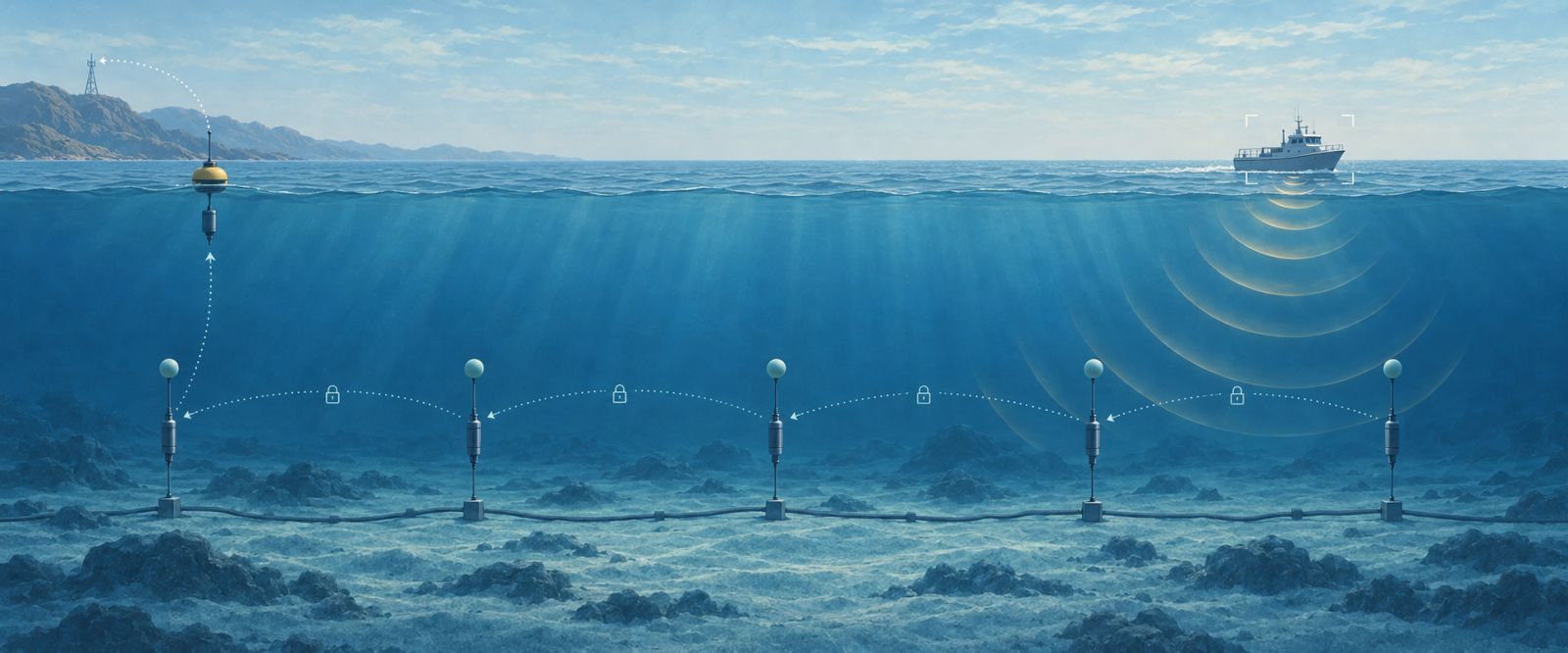
  • Passive acoustic monitoring
  • Vessel detection and classification
  • Source localization and tracking
  • Environmental and water-quality monitoring
  • Detection of unusual acoustic or environmental events
  • Monitoring of underwater infrastructure

Combining measurements from several nodes can increase spatial coverage, improve detection reliability, and reduce false alarms compared with decisions based on a single sensor.

Synchronization and cooperative processing

Many distributed sensing applications require measurements from different devices to be accurately aligned in time.

We develop synchronization, timestamp correction, and cooperative signal-processing methods that account for clock offsets, clock drift, long propagation delays, and intermittent communication.

These capabilities support time-difference-of-arrival processing, distributed localization, coherent data analysis, and reliable fusion of measurements collected by multiple nodes.

Static and mobile network integration

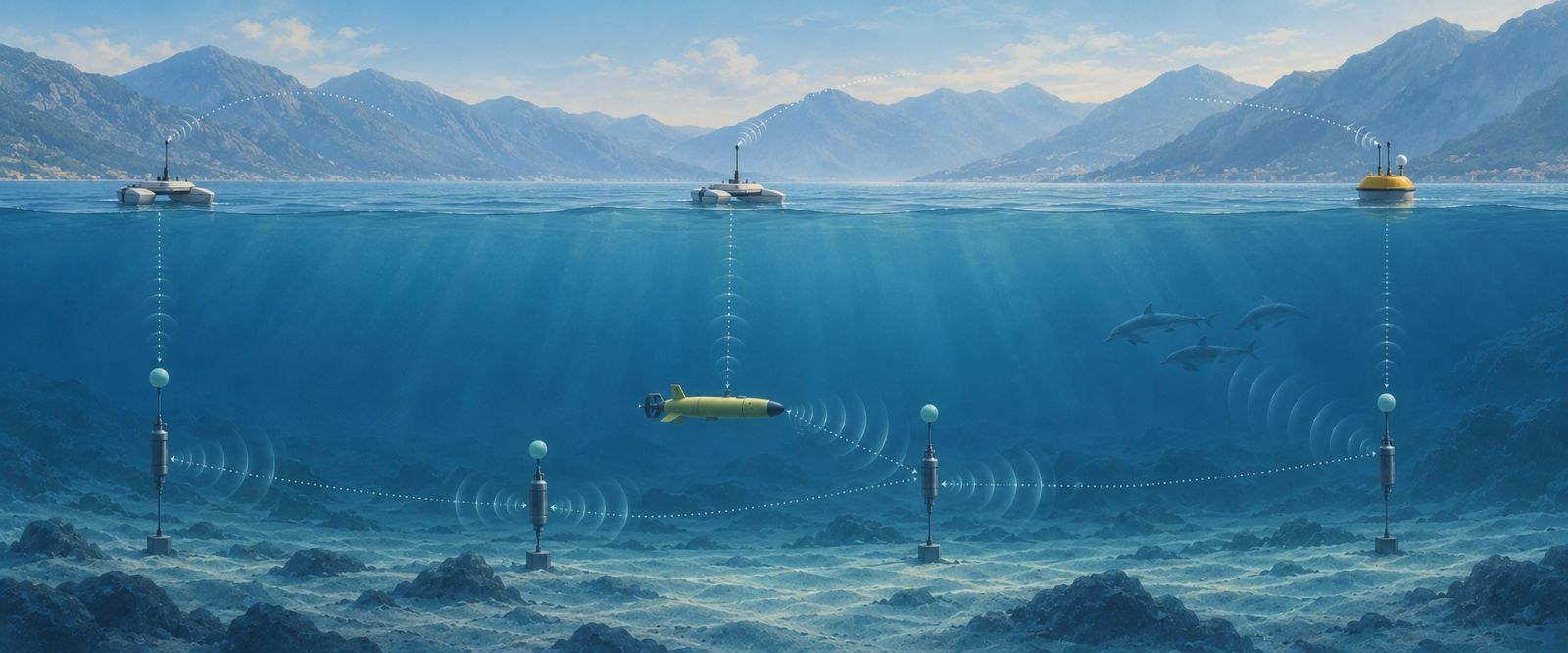
Underwater networks may include fixed seabed sensors, moored devices, autonomous underwater vehicles, autonomous surface vehicles, and surface gateways.

We investigate hybrid architectures in which mobile platforms interact with stationary networks by:

  • Collecting data from submerged nodes
  • Delivering commands and configuration updates
  • Extending communication coverage
  • Acting as temporary relays
  • Supporting localization and network calibration
  • Functioning as mobile data mules

Mobile platforms can provide connectivity to nodes that are outside direct gateway range or only intermittently reachable.

Network resilience and adaptive operation

Marine deployments are exposed to changing channel conditions, equipment failures, movement, interference, and temporary communication loss.

We develop adaptive networking mechanisms that allow systems to continue operating when individual links or nodes become unavailable. This includes dynamic route selection, local decision-making, temporary data storage, retransmission management, and reconfiguration of communication schedules.

The objective is to create networks that degrade gracefully rather than fail completely when conditions change.

Underwater-to-surface connectivity

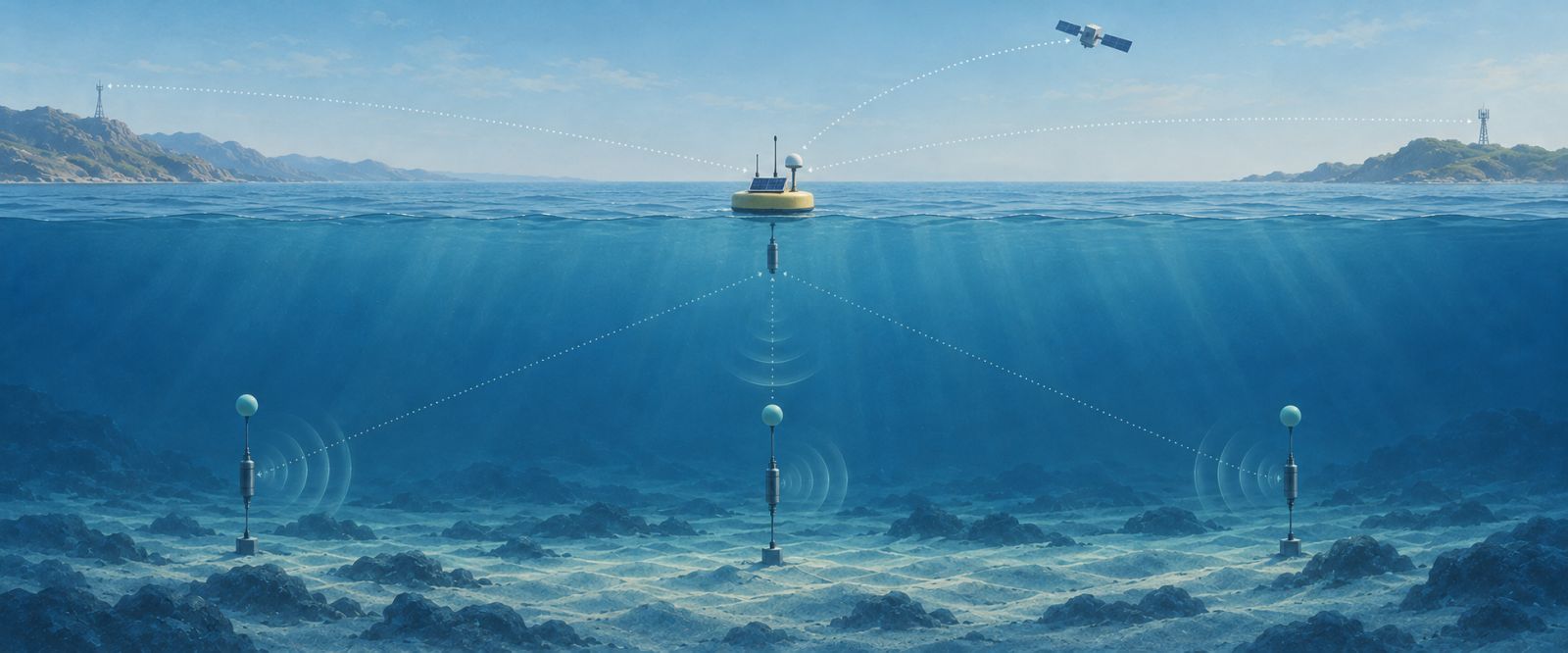
Underwater sensor networks must eventually transfer information to operators, cloud platforms, or terrestrial communication systems.

We develop gateway architectures that bridge acoustic networks with surface technologies such as:

  • LoRa
  • LTE-M and NB-IoT
  • Satellite communication
  • Wi-Fi and local radio links
  • Remote monitoring platforms

These gateways support bidirectional communication, allowing sensor data to be transferred to shore while commands, configuration updates, and mission instructions are sent back to underwater devices.

Our vision

Our goal is to develop underwater networks that can operate reliably over long distances, coordinate distributed sensing devices, adapt to changing marine conditions, and remain operational for extended periods with limited energy resources.

By combining communication protocols, distributed sensing, cooperative processing, autonomous platforms, and surface gateways, we aim to enable scalable underwater systems that transform isolated devices into intelligent and resilient marine networks.