Research area

Underwater Security and Authentication

Protecting and authenticating underwater networks

Research Overview

Exploring New Frontiers in Underwater Security and Authentication

Underwater networks increasingly support environmental monitoring, infrastructure supervision, and security applications, which makes the integrity of their data and communications essential. The acoustic channel is a broadcast medium, so transmissions can be intercepted, imitated, or disrupted, while limited energy, bandwidth, and connectivity make many conventional security mechanisms impractical.

Our research develops methods for verifying the identity of communicating devices, detecting unauthorized transmitters, and protecting underwater networks, combining acoustic channel characteristics, statistical learning, physical-layer authentication, and lightweight decentralized security architectures.

Research Programme

Research workstreams

Distinct lines of enquiry, connected by one shared validation pathway.

Threat analysis for underwater networks

Effective protection begins with understanding how underwater networks can be attacked and which assets are most at risk.

We analyse threats such as:

  • Eavesdropping on acoustic transmissions
  • Impersonation of legitimate devices
  • Replay of previously captured messages
  • Jamming and deliberate interference
  • Routing attacks that divert or drop traffic
  • Physical capture or tampering of deployed nodes

Threat models guide the design of security mechanisms that match the capabilities and constraints of underwater devices.
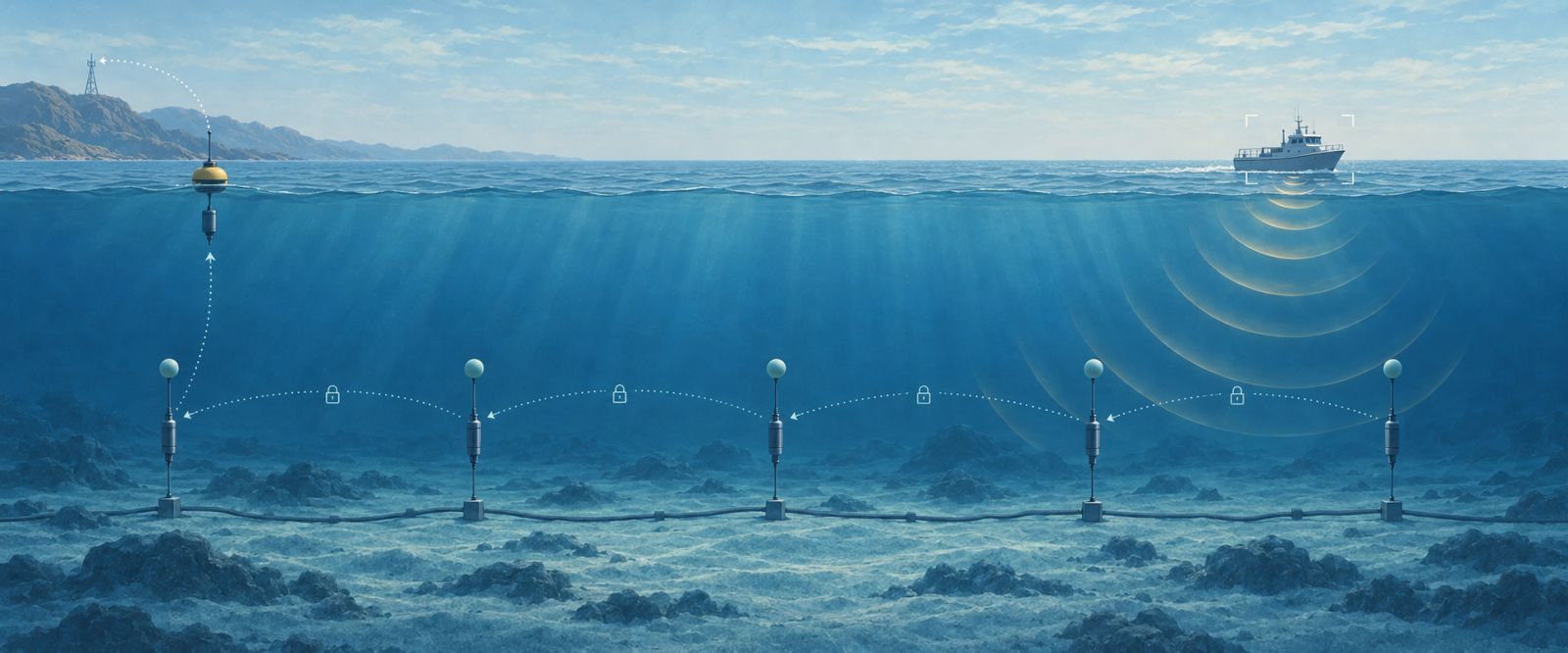
Physical-layer authentication

Every underwater link has characteristic features shaped by the positions of the devices, multipath propagation, and the hardware that transmits and receives the signals. These features are difficult for an attacker at a different location to reproduce.

We investigate authentication based on:

  • Channel impulse response and multipath structure
  • Delay and Doppler characteristics
  • Received signal statistics
  • Hardware-specific transmitter fingerprints
  • Combinations of physical-layer features with conventional credentials

Physical-layer authentication can verify devices with little additional communication and computation, which is valuable in energy-limited networks.

Detection of unauthorized transmitters

An unauthorized transmitter may attempt to inject false data, disrupt communication, or gather information about the network.

We develop detection methods that use statistical testing and learning to recognise transmissions that do not match the expected behaviour of legitimate devices, together with techniques for estimating the location of suspicious sources from measurements taken by multiple nodes. The research focuses on keeping false alarms low while channel conditions change naturally over time.

Decentralized authentication

Centralized authentication requires reliable access to a trusted server, which is rarely available underwater, where connectivity is intermittent and delays are long.

We investigate decentralized authentication schemes, including blockchain-assisted approaches, in which trust is distributed across network nodes. This research addresses:

  • Authentication without a permanently reachable central authority
  • Tamper-evident records of device identities and events
  • Lightweight agreement protocols suited to slow acoustic links
  • Secure registration and revocation of devices
  • Tolerance to node failures and network partitioning

Lightweight cryptography and key management

Cryptographic protection must fit the limited processing power, memory, and energy of underwater devices, as well as the small packet sizes of acoustic links.

Our research includes:

  • Lightweight encryption and message authentication
  • Efficient key establishment and renewal
  • Key distribution in intermittently connected networks
  • Protection against message replay and modification
  • Minimizing security overhead in transmitted packets

The goal is to provide confidentiality and integrity without significantly shortening device lifetime.

Resilient and secure network operation

Security mechanisms must keep the network operating even while it is under attack or partially compromised.

We develop trust management, secure routing, jamming-resilient communication, and intrusion detection methods that allow underwater networks to isolate misbehaving nodes, route around compromised areas, and continue delivering critical data. The objective is graceful degradation rather than complete failure when security incidents occur.

Our vision

Our goal is to develop underwater networks whose data can be trusted, whose devices can be reliably identified, and which continue to operate safely in the presence of interference and deliberate attacks.

By combining physical-layer techniques, statistical learning, decentralized trust, and lightweight cryptography, we aim to make security an integral part of underwater systems rather than a costly addition.