Research area

Marine Robotics and Autonomous Systems

Autonomous vehicles for exploration and monitoring

Research Overview

Exploring New Frontiers in Marine Robotics and Autonomous Systems

Autonomous underwater and surface vehicles can reach places that fixed instruments cannot, carry sensors across large marine areas, and operate for long periods without direct human control. Operating them reliably is difficult: satellite positioning is unavailable underwater, currents and waves disturb motion, communication with the vehicle is slow and intermittent, and every manoeuvre consumes limited onboard energy.

Our research develops navigation, guidance, control, and cooperation methods that allow marine robots to operate safely and efficiently, both individually and as coordinated teams integrated with fixed sensing infrastructure.

Research Programme

Research workstreams

Distinct lines of enquiry, connected by one shared validation pathway.

Underwater navigation and localization

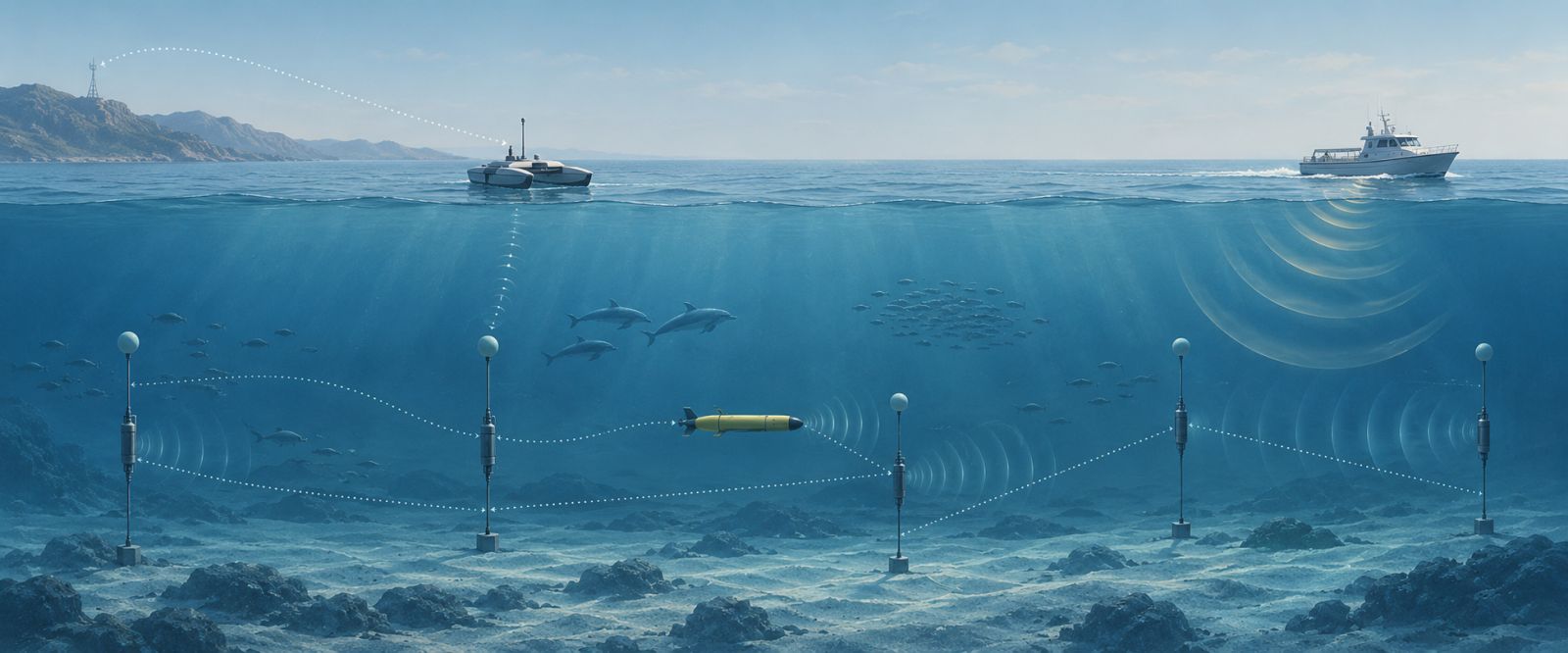
Satellite navigation signals do not propagate underwater, so submerged vehicles must estimate their position from onboard sensors and acoustic references. Small errors accumulate over time, and positioning accuracy directly affects the quality of collected data.

We investigate navigation and localization methods based on:

  • Inertial navigation and dead reckoning
  • Doppler velocity log measurements
  • Acoustic positioning relative to fixed or surface references
  • Range measurements from acoustic modems
  • Fusion of measurements from multiple sensors
  • Cooperative localization within vehicle teams

The objective is to bound navigation drift during long missions while keeping sensing and communication requirements low.
Guidance and path following

Many marine missions require a vehicle to follow a predefined path accurately, for example during seabed surveys, transect sampling, or infrastructure inspection. Ocean currents, waves, model uncertainty, and actuator limitations continually push the vehicle away from the intended trajectory.

We develop guidance and control laws that account for:

  • Ocean currents and environmental disturbances
  • Uncertainty in vehicle dynamics and hydrodynamic parameters
  • Actuator saturation and underactuation
  • Smooth transitions between mission segments
  • Changing operating conditions

Accurate path following improves the repeatability of measurements and the coverage of the surveyed area.

Cooperative formation control

Teams of vehicles can survey larger areas, collect spatially distributed measurements simultaneously, and continue a mission if one platform fails. Coordinating such teams underwater is challenging because vehicles exchange information over slow, low-bandwidth, and unreliable acoustic links.

We investigate cooperative formation control for multi-vehicle systems, including leader–follower and distributed control strategies that remain stable when communication is delayed, infrequent, or lost. Research topics include formation keeping, collision avoidance, reconfiguration of the formation, and the joint design of control and communication.

Autonomous surface vehicles

Autonomous surface vehicles operate at the boundary between the underwater environment and terrestrial communication systems. They can use satellite positioning and radio links while remaining in acoustic contact with submerged devices.

We investigate surface vehicles as:

  • Mobile gateways between underwater and surface networks
  • Navigation references for submerged vehicles
  • Communication relays for distributed sensors
  • Platforms for surface and near-surface measurements
  • Support units for multi-vehicle missions

Integration with fixed sensing platforms

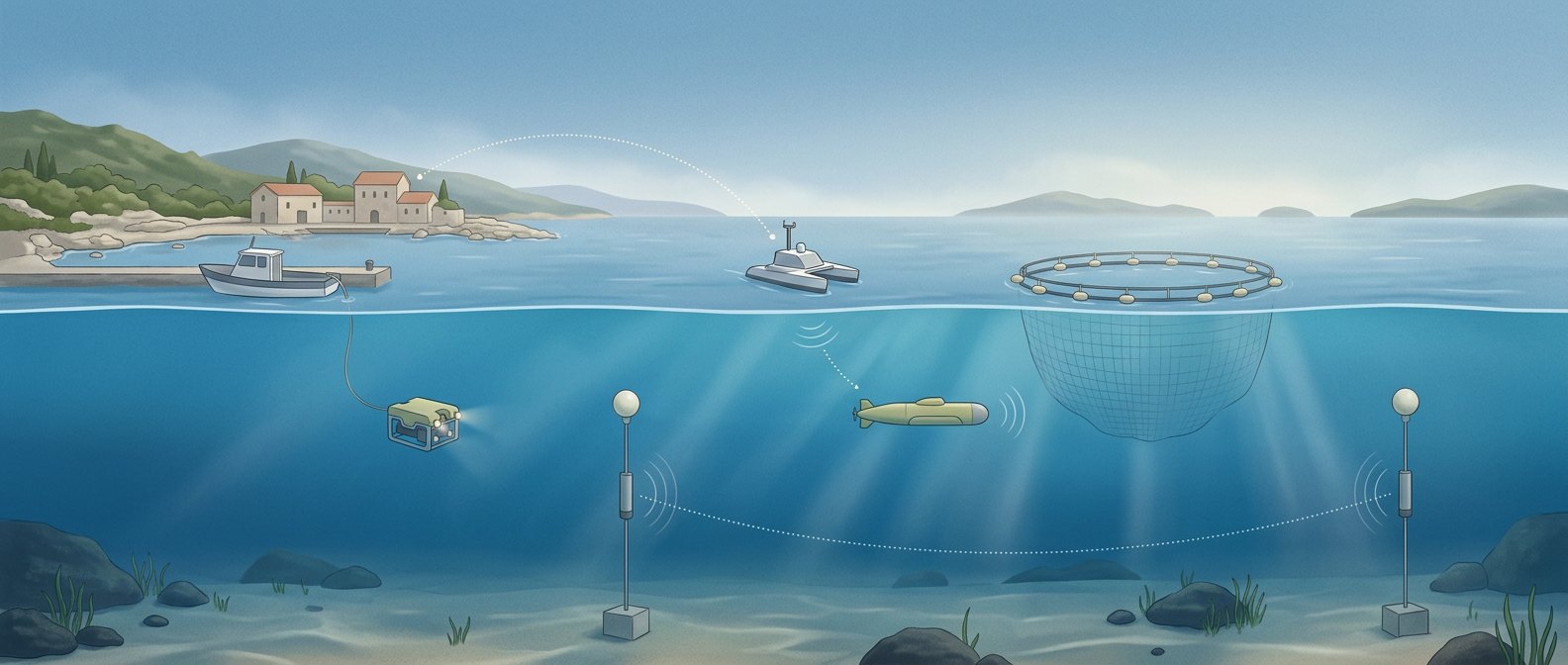
Mobile robots and fixed sensor networks are complementary. Fixed nodes provide continuous observations at known locations, while vehicles add mobility, flexible coverage, and the ability to respond to events.

We develop methods that allow vehicles to:

  • Visit sensor nodes efficiently and retrieve stored data
  • Deliver commands and configuration updates
  • Adapt sampling to events detected by the network
  • Extend coverage to areas without fixed infrastructure
  • Support calibration and localization of deployed nodes

This integration turns separate robots and sensors into one coordinated observation system.

Mission planning and onboard autonomy

Marine vehicles often operate without continuous supervision and must make decisions using only onboard information. Mission plans must also respect limited energy, changing environmental conditions, and safety constraints.

Our research includes:

  • Energy-aware mission and path planning
  • Adaptive sampling based on collected measurements
  • Onboard decision-making under uncertainty
  • Fault detection and safe recovery behaviours
  • Replanning when conditions or objectives change

The goal is to extend the time vehicles can operate autonomously while keeping missions safe and productive.

Our vision

Our goal is to develop marine robots that navigate accurately without satellite positioning, cooperate reliably over limited acoustic links, and operate safely for extended periods with minimal human supervision.

By combining navigation, control, cooperative autonomy, and integration with fixed sensor networks, we aim to enable flexible robotic systems that extend the reach of marine observation beyond what fixed instruments alone can achieve.