Research area

Artificial Intelligence for Underwater Systems

Machine learning for autonomous underwater systems

Research Overview

Exploring New Frontiers in Artificial Intelligence for Underwater Systems

Underwater systems generate complex data and operate in conditions that are difficult to model precisely. Acoustic channels change over time, noise sources vary, and environmental processes interact in ways that fixed rules and hand-tuned algorithms often fail to capture.

Our research applies machine learning to underwater communications, networking, signal detection, and environmental monitoring, with a focus on methods that are reliable, efficient enough for resource-constrained devices, and validated with real underwater data.

Research Programme

Research workstreams

Distinct lines of enquiry, connected by one shared validation pathway.

Learning-based underwater communication

Underwater acoustic channels exhibit multipath propagation, Doppler shifts, and fast time variation that challenge conventional receiver design. Data-driven methods can learn channel behaviour directly from received signals.

We investigate machine learning for:

  • Channel estimation and prediction
  • Equalization and signal detection
  • Automatic modulation recognition
  • Adaptive selection of modulation, coding, and transmission parameters
  • Link quality estimation

The objective is to improve communication reliability in conditions where model-based approaches lose accuracy.
Intelligent medium access and topology control

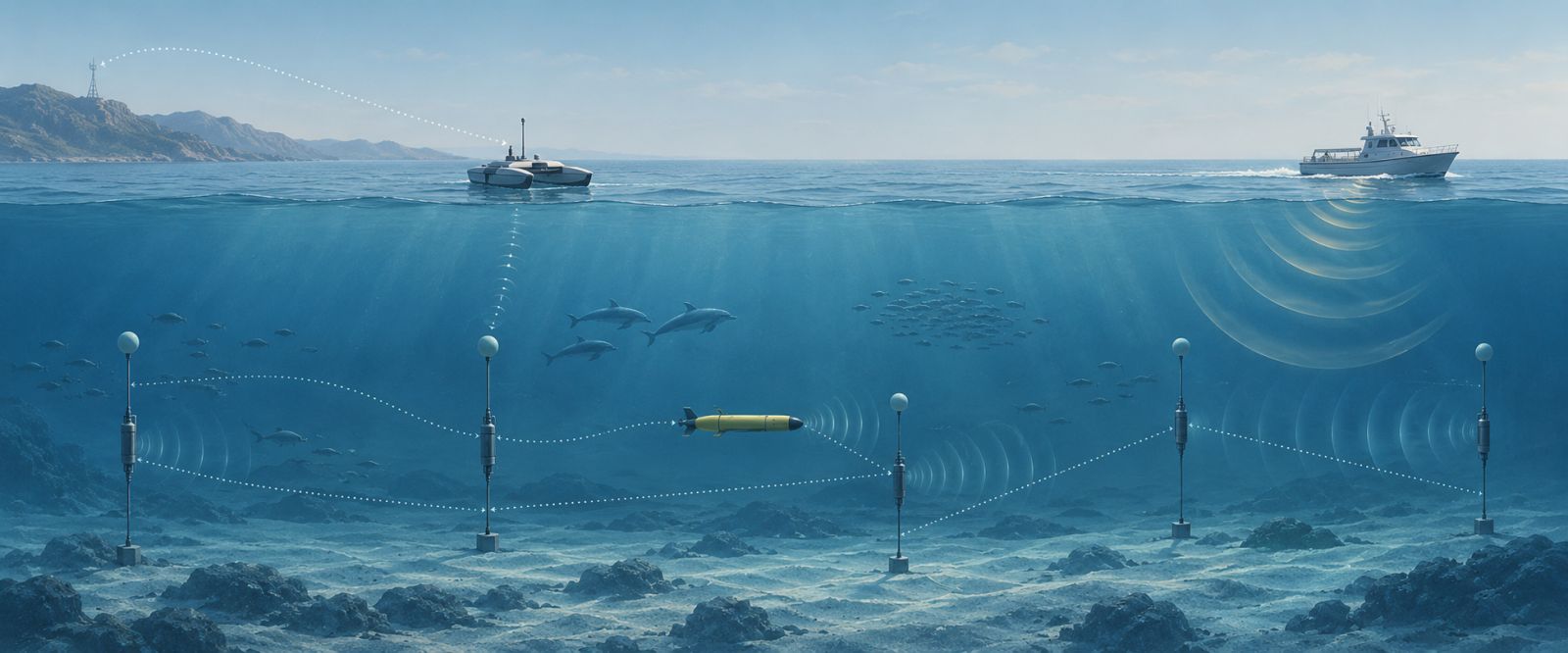
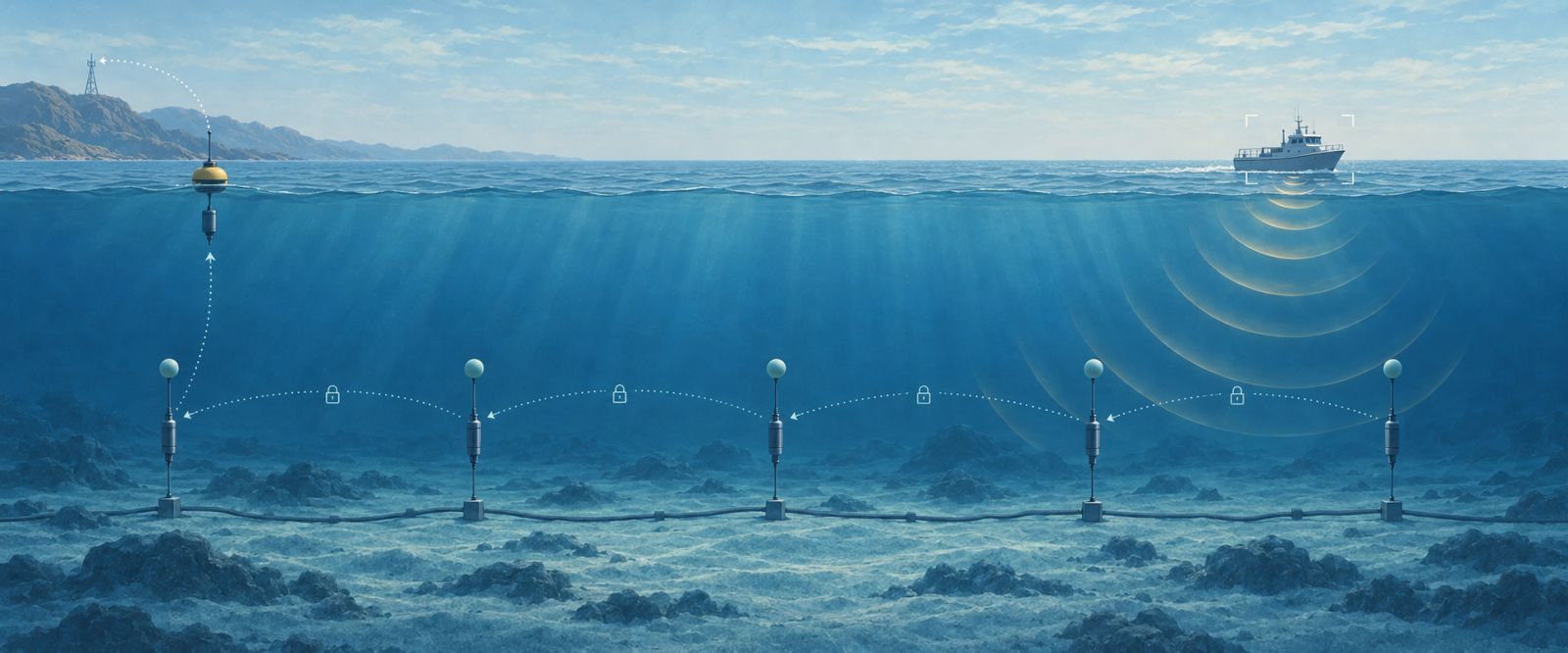
Network protocols must decide when to transmit, which links to use, and how to organise the network, often with incomplete and delayed information about the state of other nodes.

We apply machine learning, including reinforcement learning, to medium access control and topology control in underwater acoustic networks. Learning-based protocols can adapt transmission schedules, power levels, and neighbour selection to traffic patterns and channel conditions, with the goal of improving reliability and energy efficiency compared with fixed protocol rules.

Acoustic signal detection and classification

Passive acoustic recordings contain sounds from vessels, marine life, natural processes, and human activities, often overlapping and masked by noise.

We develop learning-based methods for:

  • Detection of weak signals in background noise
  • Vessel detection and classification
  • Recognition of marine mammal and fish sounds
  • Identification of unusual acoustic events
  • Separation of overlapping sound sources

Automated analysis makes it possible to process long recordings and continuous data streams that would be impractical to review manually.

Environmental data analysis

Long-term environmental monitoring produces large multivariate time series from physical, chemical, biological, and acoustic sensors.

We apply machine learning to:

  • Anomaly and event detection
  • Short-term forecasting of environmental parameters
  • Reconstruction of missing or corrupted measurements
  • Detection of sensor drift and faults
  • Fusion of data from heterogeneous sensors

These methods help turn raw sensor data into timely and trustworthy information for researchers and decision-makers.

Embedded and edge intelligence

Transmitting raw data from underwater devices is expensive in energy and bandwidth. Processing data directly on the device allows only relevant information to be sent.

Our research includes:

  • Lightweight models for low-power processors
  • Model compression and quantization
  • On-device detection and classification
  • Local decisions about which data to transmit
  • Energy-aware scheduling of computation and communication

Edge intelligence reduces communication load and enables faster local responses to detected events.

Trustworthy and data-efficient learning

Labelled underwater data are scarce and expensive to collect, and models trained in one location or season may not perform well in another.

We investigate transfer learning, simulation-based training, data augmentation, and uncertainty estimation so that models can be trained with limited data, generalize to new conditions, and indicate when their predictions should not be trusted. Interpretability is also important, so that operators and scientists can understand and verify automated decisions.

Our vision

Our goal is to develop underwater systems that interpret their own data, adapt to changing conditions, and make reliable decisions with limited energy, bandwidth, and human supervision.

By combining machine learning with communication engineering, signal processing, and marine science, we aim to make underwater systems more autonomous while keeping their decisions efficient, transparent, and validated in real-world conditions.